Meta Description
Learn how to prepare production-ready artwork for custom challenge coins. Covers file formats, color matching, design tips, and a complete checklist to reduce revisions and speed up production.
High-quality custom challenge coins begin with clear, production-ready artwork. Providing the correct file format, practical design details, and complete manufacturing instructions can reduce revisions, shorten approval time, and help the finished coins match your expectations.
|
1. Prepare Clear and Editable Artwork
Vector files such as AI, EPS, PDF, SVG, or CDR are preferred because they can be resized without losing quality. High-resolution PNG or JPG files (minimum 300 DPI) may also be accepted, but unclear or low-resolution images often require additional artwork reconstruction — which adds time and cost. Convert all fonts to outlines and include original logo files whenever possible.
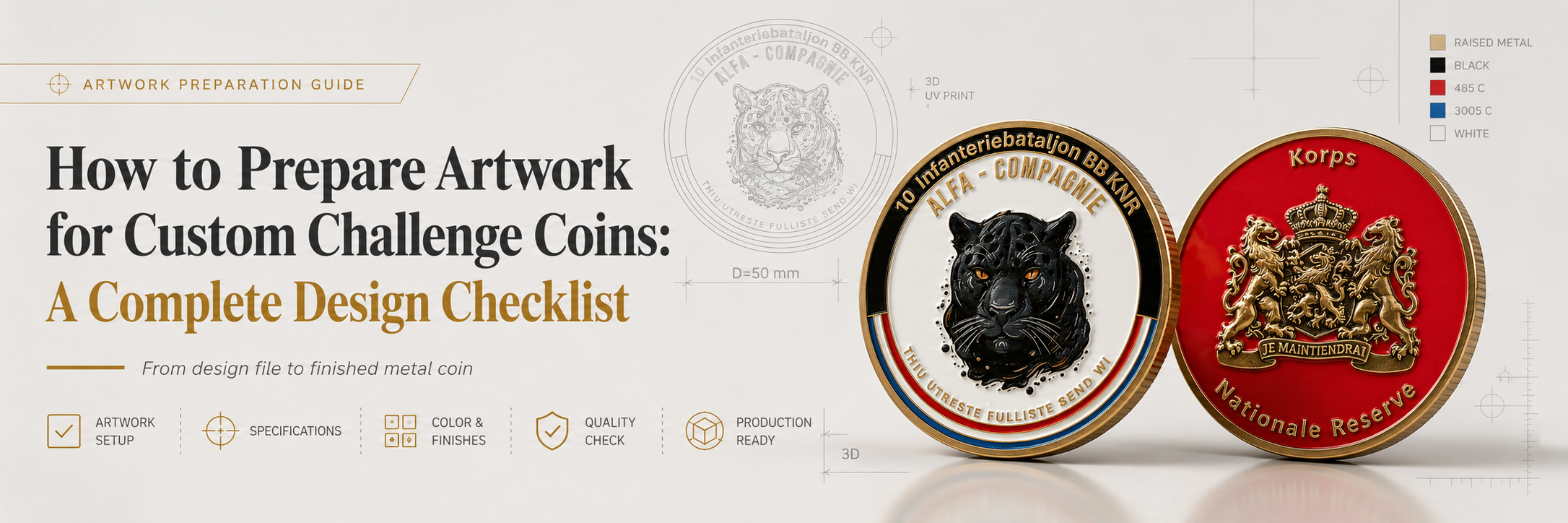
The artwork should match the intended coin size and show both the front and back designs. Standard coin sizes range from 1.5 inches (38 mm) to 2 inches (50 mm). Round coins are the most cost-effective, while custom shapes offer stronger visual impact. Leave enough breathing room for logos, borders, lettering, and decorative details. A professional challenge coin manufacturer can recommend suitable dimensions based on your design complexity, intended use, and budget.
|
2. Define Colors, Metal Areas, and Fine Details
Clearly identify which areas should be raised, recessed, polished, engraved, or filled with enamel. Raised metal is commonly used for logos and important text, while recessed areas create depth and visual contrast. Each enamel color should be separated by a visible metal line to improve production consistency.
Avoid extremely small text (minimum 4 pt at actual size), narrow gaps below 0.3 mm, and thin lines that may become unclear once struck in metal. Simple bold fonts and clean outlines consistently produce better results. Pantone color references are strongly recommended for branded projects — screen colors vary between devices and cannot be relied on for production matching. Gradients and photographic effects may require UV printing instead of traditional enamel. For detailed 2D or 3D custom military coins, include notes showing the intended relief levels and surface treatments.
|
3. Confirm All Production Requirements
Before requesting a quotation, provide the following details upfront: coin size, thickness (standard: 2.5 mm to 4 mm), quantity, plating color (gold, silver, antique bronze, black nickel, etc.), enamel type (soft or hard), edge style, packaging, delivery date, and shipping destination. Special features such as sequential numbering, laser engraving, epoxy coating, cutouts, or custom edge text should also be clearly marked on the artwork.
Review the digital proof carefully before approving mold production. Check: spelling, dates, dimensions, colors, front and back orientation, raised and recessed areas, plating finish, and edge details. Written approval gives both buyer and manufacturer a clear production reference and helps prevent costly changes after manufacturing begins.
|

 EN
EN


 Hot News