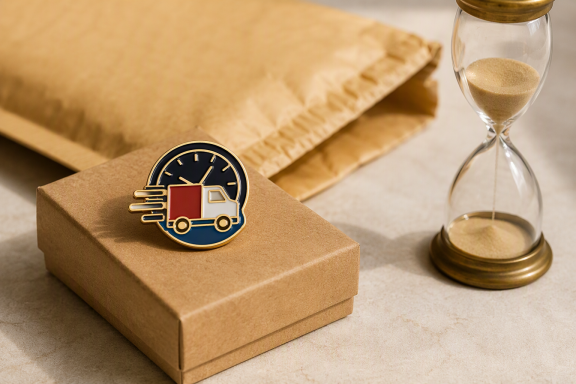
What can realistically be compressed when a custom pin order is already late — rush sampling, moulds, and freight, explained by a 21-year OEM/ODM factory.
The event date is fixed and the order has not been placed — that is the most common call we take in Q4. Standard production runs 20–35 days and sampling takes another 7–10, so the only way to hit a tight date is knowing which stages can be compressed and which ones have a physical floor. Spend your urgency on the wrong stage and you pay rush fees without arriving any earlier.
Custom lapel pins can often be accelerated more than buyers expect — if the artwork, finish, and packaging decisions are settled first.
Lead-Time Stage |
Standard |
Compressible? |
How |
Artwork & 3D proof |
2–4 days |
Yes — fastest win |
Approve existing vector artwork; skip revision rounds |
Sampling |
7–10 days |
Partly |
Rush sample, or approve a digital proof against agreed tolerance |
Mould / tooling |
3–7 days |
Limited |
Reuse an existing mould or share one across award tiers |
Production |
20–35 days |
Some |
Fewer finishes and enamel colours; drop per-piece personalisation |
Personalisation (names, dates) |
Added before packing |
No |
It is a final-stage operation; split it into a second batch |
Freight |
Varies by mode |
Yes |
Air or sea — choose by the date you must hit, not by habit |
Moulds have a physical floor: A new tool has to be cut and tested; no amount of urgency removes that step.
Plating and enamel run in batches: Colour changes and extra finishes add setup, which is where late orders usually lose days.
Personalisation is the last operation: Engraved names or dates cannot be applied until the piece is finished.
Your approval is the one step only you can complete: Artwork sign-off and sample approval sit on your side of the timeline.
Confirm the date before discussing price: Tell us the in-hand date first so the schedule is built backwards from it.
Lock artwork before production starts: Each revision round costs days; send final vector files, not drafts.
Reduce finishes and enamel colours: One plating and a small palette run faster than a multi-colour, multi-finish design.
Reuse tooling where possible: An existing mould removes the longest fixed step in the schedule.
Approve digital proof first, physical sample second: Use the digital proof to settle design, and the physical sample to confirm finish.
Keep spares in the order: Add 5–10% extra so a late addition does not trigger a second production run.
Choose the mode by date, not by habit: Ask for both air and sea options with their transit times and prices before you decide.
Packaging affects volume weight: Rigid boxes add volume; confirm how packaging changes the freight calculation.
Allow for customs: Clearance sits outside production, so it has to be part of the date you plan against.
Split deliveries if needed: Shipping a partial batch early can protect the event while the balance follows.
A tight deadline is decided by how fast a factory can answer, quote, and start — not by how fast it can print a price. The same die-striking and plating craftsmanship behind our custom challenge coins and custom sports medals goes into every Unitepins order, with free design mockups and no MOQ for samples from our 5,100 m² facility with 21 years of OEM/ODM experience.
Q: Can you guarantee a rush order will arrive on time?
A: No factory can guarantee a date that depends on moulds, plating batches, and customs. What we do is confirm the earliest realistic date before you commit, and tell you plainly where it stops being possible.
Q: What slows a rush order down the most?
A: Late or changing artwork, extra plating and enamel colours, and per-piece personalisation. Settle those first and the schedule holds.
Q: Is air freight worth the extra cost?
A: It depends on the date you must hit. We quote both modes with their transit times so you can weigh cost against arrival date rather than guessing.
Q: What is the minimum order for a rush job?
A: MOQ typically starts at 100–500 pcs depending on design complexity, and sample development has no minimum — which is often the fastest way to lock a design under time pressure.
Q: Which products are easiest to accelerate?
A: Designs that reuse an existing mould, use a single plating and a short enamel palette, and skip engraved names. Those can usually move through the line fastest.

Our custom products include lapel pins, 3M Sticker Pins, Challenge coins, Golf ball marker, Keychains, Medals, Bottle openers, Belt buckles, Cuff-links, Lanyards, etc.
 EN




 Hot News