Source custom belt buckles wholesale from an OEM/ODM factory. MOQ 100–500 pcs by design and process. Send your logo for free design mockups and a quote.
A belt buckle order rarely fails on price; it fails on fit. The strap width, the attachment type and the depth of relief are usually decided in a different conversation from the one that approved the artwork, and the mismatch only becomes visible when the sample is threaded onto a belt. With sampling at 7–10 days and production at 20–35, that discovery costs far more than a colour change does.
Custom belt buckles are a different order of product from pins and coins: heavier, larger, and much less forgiving of a small dimensional error — which is why the specification has to come before the design.
Buckle Type |
How It Is Made |
Best For |
Limitation |
Die-struck plaque buckle |
Stamped from brass or zinc sheet, then plated |
Fine detail, flat faces, corporate and promotional |
Low relief; deep 3D shapes are not possible |
Die-cast buckle |
Molten zinc alloy poured into a steel mould |
Sculptural designs, western and lifestyle retail |
Higher mould cost; fine text comes out softer |
Etched or laser plate buckle |
Sheet metal etched, then plated |
A large flat area for a logo or a date |
Shallow depth; reads through contrast, not relief |
Enamel-filled buckle |
Die-struck base with hard or soft enamel |
Colour logos, club and association crests |
Enamel sits in recesses; tight corners need care |
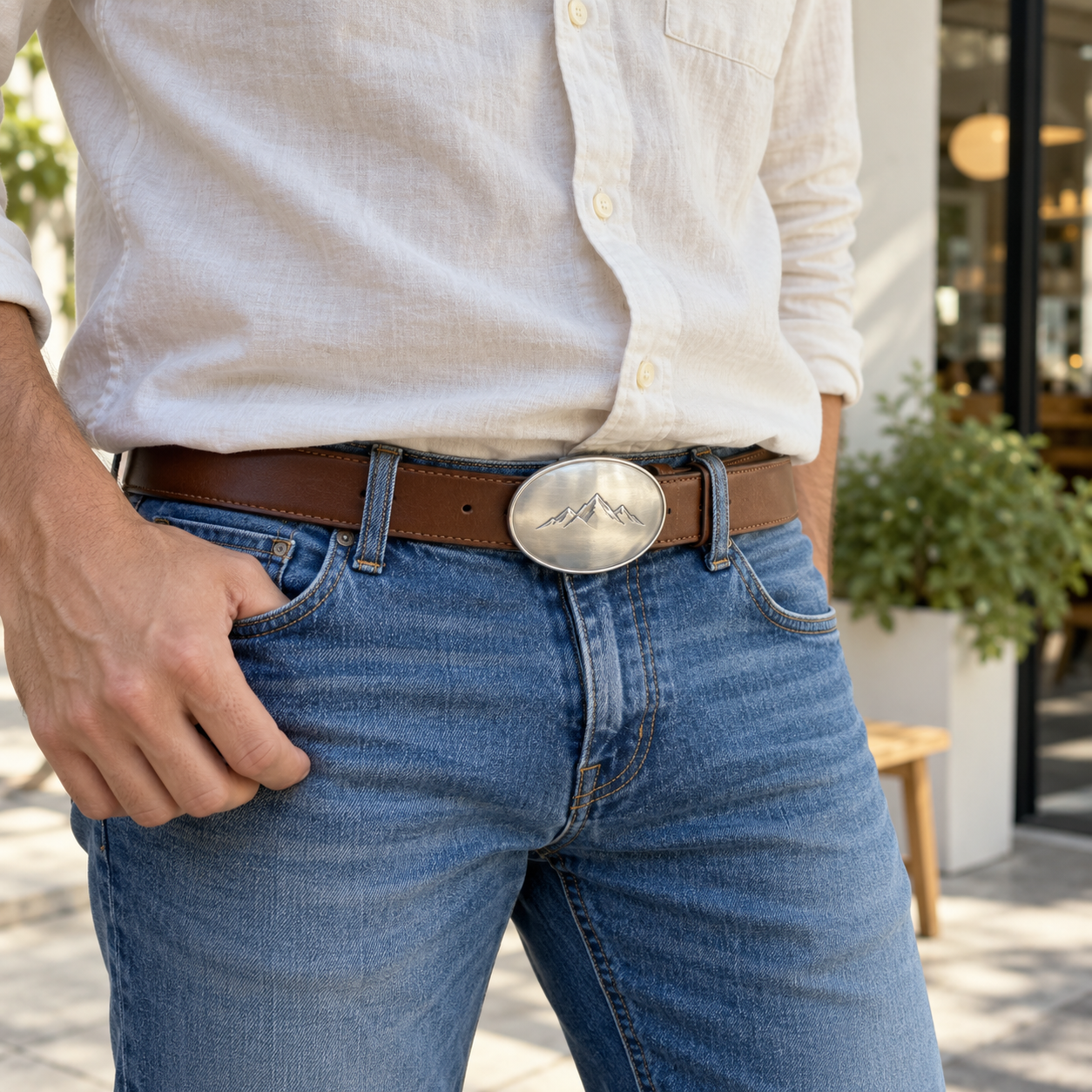
Confirm the strap width first: 30, 35 and 40 mm are the common widths. The buckle opening is cut to the width you nominate and cannot be adjusted afterwards.
Prong, clamp or screw: A prong buckle needs a punched strap; a clamp or screw fitting attaches to a finished strap. Mixing the two is the most common source of rework.
Buckle only, or buckle with the strap: Decide before quoting — it changes the packing, the weight and the freight, not just the unit price.
Curvature and radius: A buckle that curves to the waist sits differently from a flat plate; confirm the radius on the drawing rather than on a render.
Weight in grams: Cast buckles are noticeably heavier. Check the gram weight against both the balance of the belt and the shipping cost.
Ask for the dimensional drawing: A drawing is checkable; a photograph is not. Measure the sample against the drawing before approving.
A belt abrades more than a pin: Constant contact with the strap, tables and clothing wears plating faster than occasional wear, so specify the harder finishes.
Antique finishes hide wear: Antique brass, antique silver and matte black conceal scratches that polished surfaces show within weeks of daily use.
Engrave after plating: Engraving cut before plating fills with metal and loses definition; the sequence belongs in the specification.
Keep soft enamel away from the contact face: Soft enamel leaves the colour recessed and raised metal exposed, which is what rubs against the strap on a buckle.
Match the plating to the strap hardware: If the belt has a keeper or a tip in a different finish, the two will read as a mismatch in daylight.
Brand workwear and uniforms: A buckle with the company mark survives years of daily use, which is a longer exposure than any garment print.
Western and lifestyle retail: This is the category where die-cast relief and a heavier feel are the product, not a detail.
Retirement and milestone gifts: An engraved buckle with a name and a date is a personal award that gets worn rather than stored.
Club and association membership: A crest in enamel gives a membership item that members actually keep.
Corporate gifting with a strap: Buckle plus strap in one box moves the item from accessory to gift.
Private label for retail: Consistent plating and dimensions across repeat orders matter more here than any single design.
Most buckle problems are decided in the first two steps, long before a mould is cut. Work through the sequence in order:
1. Fix the width and the attachment: Strap width plus prong, clamp or screw. Everything downstream depends on this pair of decisions.
2. Choose the process by the relief: Flat detail points to die-struck or etched; sculptural depth points to die-cast. Choosing by unit price first produces a design the process cannot hold.
3. Approve the dimensional drawing: Width, height, thickness, opening size, radius and gram weight — on paper, before tooling.
4. Confirm the tooling arrangement: Mould cost is a one-off; agree whether it is charged once, amortised into the unit price, or waived above a quantity.
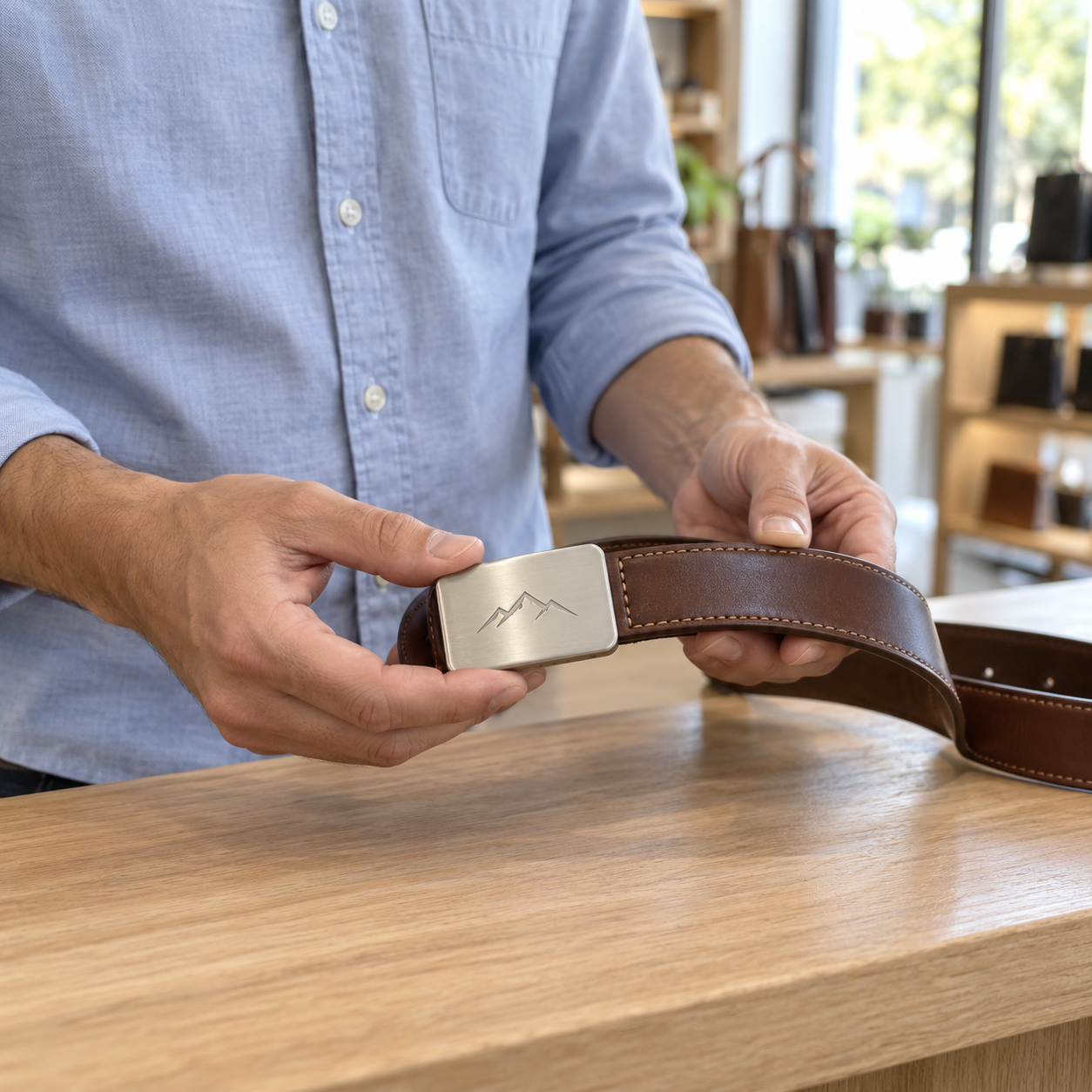
5. Approve the sample on a strap: Thread it, fasten it, and check the prong alignment under load. A sample judged loose on a desk hides the one fault that matters.
6. Set the QC points: Prong alignment, plating adhesion, engraving depth and edge finish are the four checks that catch a bad batch before it ships.
7. Build the schedule backwards: Sampling 7–10 days, production 20–35 after approval, with a new mould ahead of sampling and freight behind production.
Buckles sit on the same die-striking, casting and plating lines as the rest of our metal work, which is why the same tolerance discipline applies to a custom challenge coins order and to a custom lapel pins order. Every Unitepins order includes free design mockups and no MOQ for samples, from a 5,100 m² facility with 21 years of OEM/ODM experience.
Q: What is the difference between die-struck and die-cast buckles?
A: Die-struck buckles are stamped from sheet metal, which holds crisp detail but only low relief. Die-cast buckles are poured into a mould, allowing deep three-dimensional shapes at a higher tooling cost and with slightly softer fine text.
Q: Can the buckle be supplied with the strap?
A: Yes. It can be quoted alone or as a finished belt, but the strap width and attachment type have to be fixed first, because the buckle opening is cut to that width.
Q: How long does production take?
A: Sampling runs 7–10 days and bulk production 20–35 days after sample approval. A new mould adds time ahead of sampling, so that stage sits on the critical path.
Q: Which plating holds up best in daily wear?
A: Antique and matte finishes hide scratches better than polished ones. Specify the harder plating options and keep soft enamel away from surfaces that rub against the strap.
Q: What is the minimum order?
A: MOQ typically starts at 100–500 pcs depending on design complexity and process, and sample development has no minimum.

Our custom products include lapel pins, 3M Sticker Pins, Challenge coins, Golf ball marker, Keychains, Medals, Bottle openers, Belt buckles, Cuff-links, Lanyards, etc.
 EN




 Hot News