 EN
EN


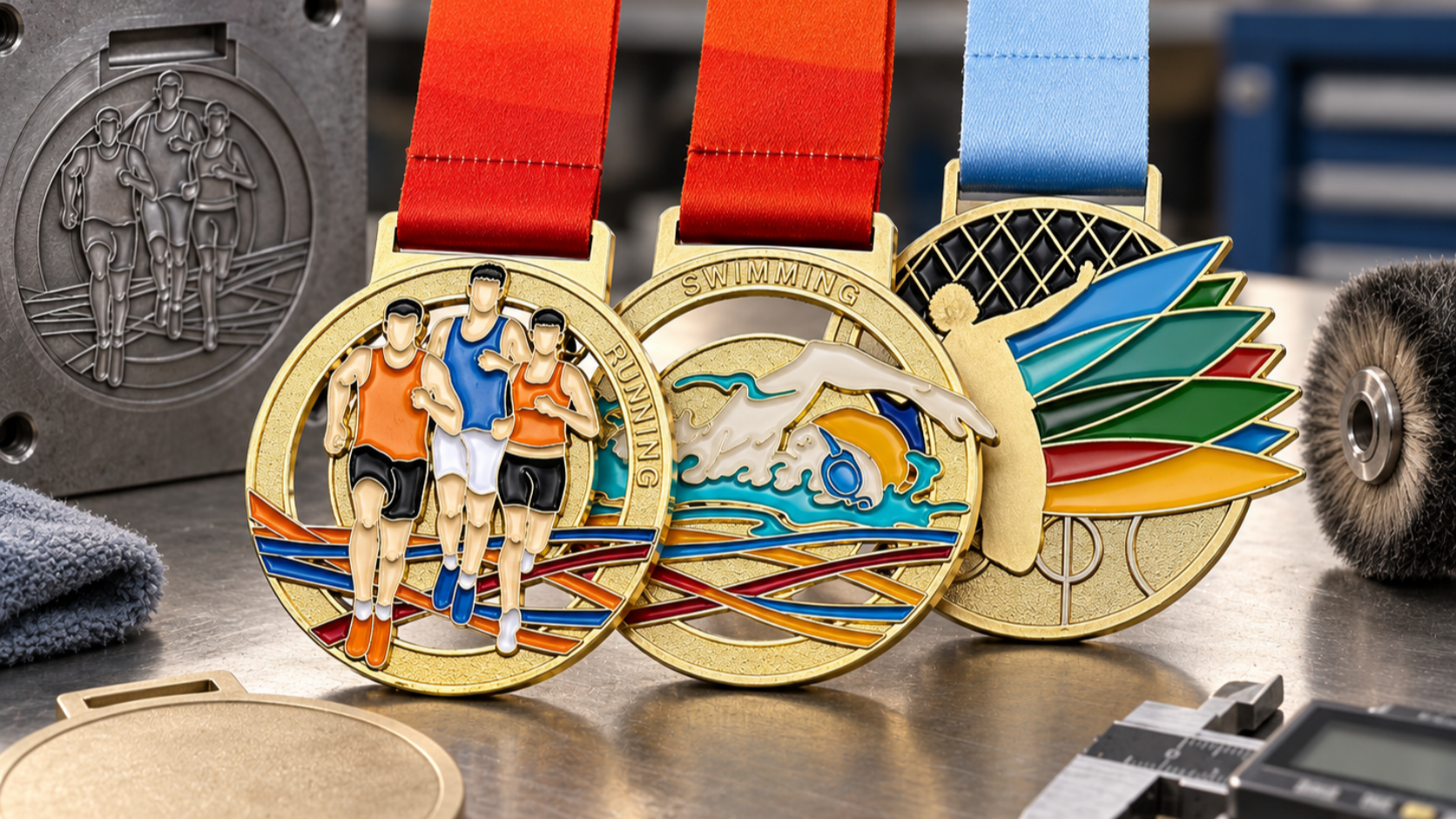
A sports medal is a physical audit of a supplier’s process discipline — alloy grade, die accuracy, plating thickness, and inspection coverage all decide whether the award still looks new after years of handling and display. For event organizers and athletic programs buying in volume, understanding the five stages below — material preparation, die casting, design engineering, finishing, and quality verification — is the fastest way to compare quotes that otherwise look identical on paper.
Each stage changes a measurable outcome: how quickly the surface tarnishes, how sharply the relief reproduces, and how consistently 5,000 pieces match the approved sample. Skip one control and defects scale across the whole batch.
1. Alloy Selection — the First Durability Decision
Manufacturers cast most award pieces from zinc alloy, brass, or copper because these metals balance castability, weight, and cost at production scale. Zinc alloy dominates high-volume runs: it fills complex dies at lower melting cost and keeps unit pricing predictable. Brass and copper appear on premium lines, where buyers accept higher material cost in exchange for a warmer tone and stronger natural corrosion behaviour. Whichever base is specified, ask for material certificates — metal purity directly affects plating adhesion and finish stability.
| Base material | Why it is used | Corrosion behaviour | Cost position | Common finishing route |
|---|---|---|---|---|
| Zinc alloy | Standard for high-volume orders; intricate cast detail, solid weight feel | Raw surface tarnishes; protection depends on plating | Low–mid | Gold / silver / bronze plating, optional epoxy or lacquer |
| Brass | Premium and retro lines; warm tone, plates and polishes well | Naturally resistant; develops a mellow patina | Mid–high | Polished, antique or oxidised finishes with clear lacquer |
| Copper | Designer and commemorative pieces; deep colour, ages attractively | Resistant; intentional patina can be a design feature | Mid | Antique / oxidised tones, enamel colour fills |
| Iron / steel | Budget runs where price outweighs longevity | Weakest; needs full plating plus lacquer | Low | Full plating only; avoid for outdoor use |
Before any die work, raw stock is degreased, deoxidised, and ultrasonically cleaned so that oils and rolling residues cannot weaken coating adhesion. This preparation step is the classic root cause of plating that blisters or peels months after delivery.
2. Die Casting and Tooling Precision
Die casting injects molten alloy into hardened steel dies under high pressure, reproducing fine relief at production speed. The die is where quality is decided: wall-thickness uniformity, draft angles, gate positions, and cooling channels are engineered in CAD and simulated before steel is cut, so thin features do not crack and metal fills every recess without porosity. A well-maintained die stays in service for several hundred thousand shots — tooling quality, not casting speed, sets the ceiling on consistency.
Typical specifications procurement teams should confirm before tooling begins:
- Blank diameter of 40–100 mm, with most sports awards at 50–75 mm
- Thickness of 2.5–5 mm to balance weight feel against metal cost
- Relief depth of at least 0.3 mm so highlights survive plating
- Ribbon slot sized to standard 25 mm webbing, with reinforced edges
- De-burring tolerance under 0.1 mm on all cast edges
3. Custom Design — Engineering Artwork into the Die
Design files arrive as artwork; tooling engineers translate them into three-dimensional surfaces that will actually cast. Raised emblems, recessed colour areas, and ribbon-attachment lugs are adjusted for draft and wall thickness, and the layout is validated on screen before steel cutting starts. This is why lead time is dominated by tooling: once the die is approved, large runs of custom sports medals repeat with a consistency that handcraft cannot match. A pre-production sample review at this stage is the cheapest insurance against a batch that misses the mark.
4. Finishing, Plating, and Colour
Casting leaves flash and tool lines, so batches are tumbled to smooth edges, polished to bring out depth, then plated in controlled electrolytic baths. Plating is applied in layers rather than one pass: a nickel undercoat blocks base-metal migration, the coloured layer — gold, silver, or bronze — carries the finish, and a clear protective coat locks it in. Ask suppliers to state plating thickness and salt-spray test results instead of accepting vague “quality plating” claims; a stated spec is auditable, an adjective is not.
Enamel fills, epoxy domes, and printed detail add colour over the plated layer, but each extra process is another adhesion interface — approve the full stack on one production sample before mass production begins.
5. Quality Control and Final Verification
Premium producers separate themselves from basic ones in inspection, not in marketing. Verification should cover every characteristic your order depends on:
- Dimensional and weight sampling against the approved sample
- Visual plus automated optical inspection for surface and plating defects
- Plating thickness measurement on finished pieces
- Pull-testing of ribbon attachments to a stated force
- Salt-spray and humidity exposure on samples to simulate long-term storage
These checks turn confidence into documented fact — they are what let a sports medal survive years in a medal display case without losing colour or shape. When a supplier can show test data, purchasing stops being a gamble.
FAQ
Q: How do manufacturing processes affect a sports medal’s longevity?
Through three pathways: alloy selection sets base corrosion resistance, die casting precision prevents structural weak points, and multi-layer plating with lacquer provides the protective barrier against tarnish and wear. Together they keep a quality medal presentation-ready for decades.
Q: What role does custom design play in manufacturing complexity?
Complex geometry — thin walls, sharp angles, deep relief — must be re-engineered for castability, which drives tooling cost and lead time. A good supplier flags design-for-manufacturing issues before steel is cut, so ambitious artwork ships on schedule rather than after expensive die revisions.
Q: How should organizations preserve sports medals after receiving them?
Store awards in cases with acid-free inserts and UV-protective glazing, away from humidity and temperature swings. Clean gently with a soft, dry cloth; avoid abrasive polishes that strip plating. Medals handled this way stay worthy of presentation at future ceremonies.